
Assessment-First Care For Pain, Injury, and Movement
Care begins with an assessment rather than a predetermined protocol. We consider your symptoms, how the affected area moves, relevant muscles and joints, possible neurological involvement, and the demands of your work, sport, and daily activities. Treatment is then selected according to what we find.
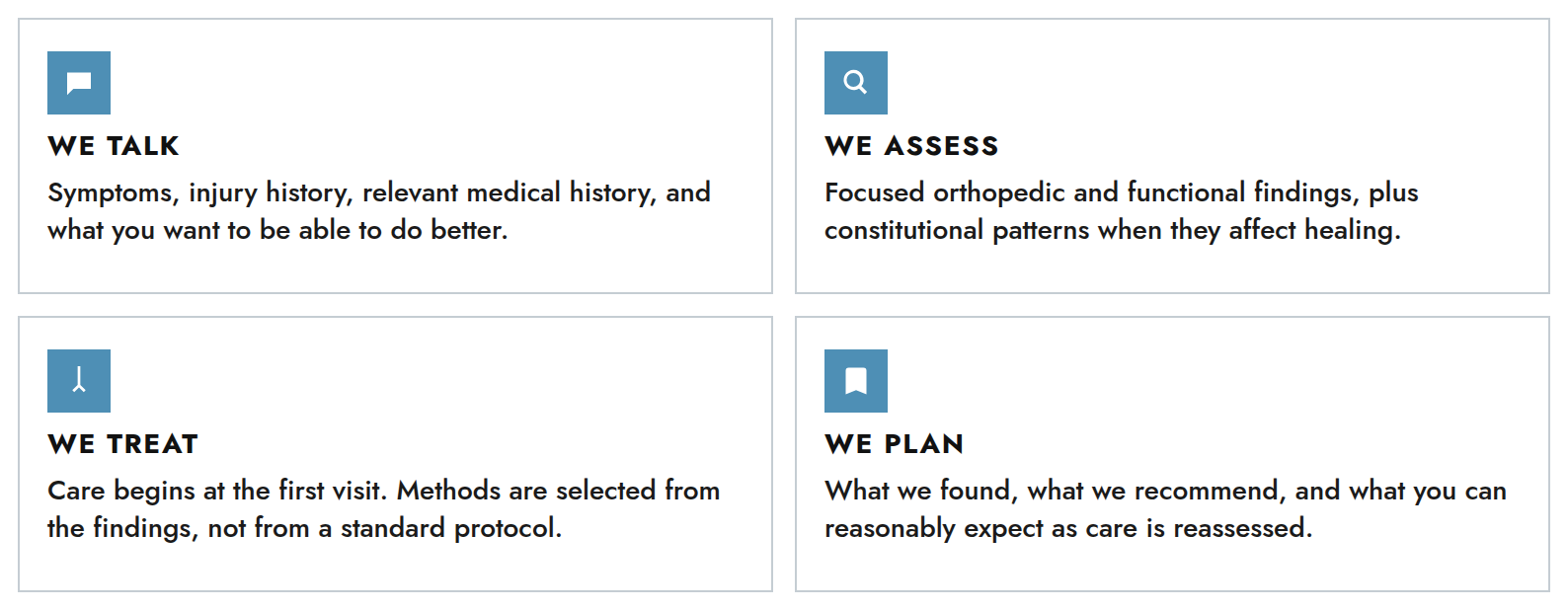
Methods are selected from the exam and may be combined in the same visit. Orthopedic acupuncture, trigger-point needling, electroacupuncture, and traditional acupuncture are not separate appointment types.
This is the primary clinical approach used at Archetype Acupuncture.
It is used for acute injuries, chronic pain, arthritis, overuse problems, post-surgical recovery, tendon and muscle problems, joint pain, and nerve-related symptoms.
Needling may be directed to local tissue, related muscles and joints, or movement and neurological patterns that are affecting the problem.
The aim is to decrease pain, restore movement, and support recovery.
(Also known as Dry Needling)
Tight, tender knots or bands in muscle can cause local pain, referred pain, stiffness, or changes in movement.
When the exam supports it, a thin acupuncture needle may be used to treat that tissue. This is commonly called dry needling. In acupuncture it is one local technique, a form of ashi needling, not a separate treatment system.
It is not used on every patient. It can be combined with other methods in the same visit when movement or nerve-related factors also need attention.
A mild electrical current is added to selected needles to influence pain sensitivity, muscle activation, and nerve-related symptoms.
It is most useful when pain has been persistent, when muscle activation has changed after injury or surgery, or when nerve-related symptoms are present. Intensity is adjusted to comfort and clinical need.
It is applied to selected needles only and can be combined with orthopedic or myofascial trigger-point needling when a region needs more than manual needle stimulation.
Traditional acupuncture is used when more than the injured tissue is involved. That includes tension, sleep, mood, digestion, or reduced recovery capacity. Assessment may include channels, organ patterns, and constitution.
The aim is to regulate the nervous system and support the body’s capacity to settle and heal. In classical terms this is the regulation of qi and blood. It is not a separate visit type.
Additional therapies may be incorporated when they are clinically appropriate.
SOFT-TISSUE MOBILIZATION
Gua Sha and instrument-assisted soft-tissue techniques may be used to address areas of restriction, improve tissue mobility, and reduce stiffness.
CUPPING | MYOFASCIAL DECOMPRESSION
Cupping uses gentle negative pressure on the skin and superficial tissues. It may be used to reduce protective muscle tension and improve tissue mobility.
PHOTOBIOMODULATION| RED LIGHT THERAPY
A full-body red and near-infrared light panel is used during needle retention. It is used to support local circulation, tissue recovery, and comfort after needling. It is part of the treatment session, not a separate appointment.
PEMF
A full-body pulsed electromagnetic field mat on the treatment table is used during the session. It is used to support tissue recovery and help settle irritation in the involved area. It is part of the treatment, not a separate appointment.
DYNAMIC COMPRESSION
NormaTec compression may be used selectively to support recovery and reduce the sensation of swelling, soreness, or post-exercise fatigue.
POSTURAL, MOVEMENT ASSESSMENT & CORRECTIVE EXERCISES
Posture and movement assessment is incorporated into care when relevant. Corrective exercises may be recommended when they can help improve mobility, strength, or movement efficiency.
These therapies are not automatically added to every treatment. They are selected according to your condition and treatment goals.
Back & Spine
Low back pain · Sciatica · Disc-related pain · Stenosis · SI joint pain · Thoracic pain · Degenerative spinal conditions
Head & Neck
Neck pain · Whiplash · Disc-related neck pain · Headaches · Migraine · Jaw dysfunction · Facial nerve conditions · Facial paralysis · Residual post-concussion symptoms
Shoulder
Rotator cuff problems · Frozen shoulder · Impingement · Labral problems · Shoulder arthritis · Scapular dysfunction
Hip
Hip pain · Arthritis · Labral problems · Femoroacetabular impingement · Gluteal tendinopathy · Bursitis · Nerve-related hip pain
Thigh & Knee
Muscle and tendon strains · Ligament injuries · Meniscus problems · Arthritis · Overuse injuries · Post-surgical knee recovery
Leg, Ankle, & Foot
Ankle sprains · Achilles problems · Plantar fascia pain · Shin splints · Nerve entrapments · Foot arthritis
Elbow & Forearm
Tennis elbow · Golfer’s elbow · Tendon injuries · Bursitis · Nerve compression · Arthritis
Wrist, Hand, & Fingers
Carpal tunnel symptoms · Tendon irritation · Trigger finger · Arthritis · Post-injury wrist or hand pain
Before & after surgery
Used before a procedure to reduce baseline pain, swelling, and protective tension, and after surgery to support pain control, tissue recovery, and return of function. Care is matched to the stage of healing.
Post-stroke & neurological recovery
Used alongside rehabilitation to support mobility, coordination, muscle tone, sensory input, and functional independence.
Post-concussion recovery
Support for headaches, dizziness, fatigue, sleep disruption, and nervous-system sensitivity. Paced to symptom tolerance.
Sports performance and training recovery
Support for recovery between sessions, movement efficiency, and training-related musculoskeletal stress. You do not have to be a competitive athlete.
Archetype Acupuncture is an authorized provider in the VA Community Care Network through TriWest Healthcare Alliance.
Eligible veterans can receive covered care at no out-of-pocket cost with a valid VA referral and authorization.
For full details on coverage, visit our Rates & Insurance page.